June - July 2024
Initial feedback from stakeholders indicates a need to address common skills gaps for pathology, which are reiterated across health and social assistance industries.
Skills gaps to address include:
-
regional healthcare settings and point of care testing
-
support for specialist environments
-
development for a range of patient handling
-
digital literacy skills
-
pre-requisite skills
-
professional responsibilities and soft skills.
Project outcomes will better align qualifications to the industry needs and regulatory requirements and will create clear and sustainable career pathways to support existing and future industry growth.
A project Technical
Committee is being established to provide expert advice. Technical Committee members are selected for their relevant expertise in the diverse project aspects.
Project fact sheet
View the Terms of Reference and Project Reference Group members.
View the Consultation Strategy.
Pathology Functional Analysis Report
Our Pathology Functional Analysis Report provides a clear and detailed overview of the diverse roles, functions and skills required across the pathology sector, including laboratory, specimen collection and support environments. It identifies the key competencies needed to meet current and emerging industry demands and supports workforce development by exploring nationally endorsed training pathways for pathology professionals. This work ensures future training products align with industry standards and enhance workforce readiness by identifying gaps and opportunities in pathology skills development.
The pathology sector is also navigating a range of industry-wide influences that are shaping the skills required of the future workforce. Advances in diagnostic technology, automation, digital pathology and data-driven health systems are transforming how pathology services are delivered, increasing the need for workers who can operate sophisticated equipment, interpret digital outputs and maintain high standards of data accuracy and cybersecurity. Workforce pressures such as rising demand for rapid diagnostics, growing service volumes and the need for stronger interdisciplinary collaboration are driving a shift toward more flexible and adaptable roles.
Additionally, many pathology workers—particularly collectors—are increasingly operating alone in remote, regional and community-based settings. This trend places heightened importance on skills such as autonomous practice, situational risk assessment, communication and managing patient care without immediate on-site support. Early desktop research also revealed that pathology employers are actively promoting roles for experienced collectors of blood from children, highlighting paediatric phlebotomy as a specialised and valued capability within parts of the industry. As a result, future pathology professionals will require enhanced technical proficiency, digital literacy, problem-solving capability, paediatric collection skills where relevant and a strong understanding of quality systems, regulatory requirements, and patient-centred service delivery.
Methodology
To ensure accuracy and relevance, the functional analysis process incorporated both desktop research and stakeholder interviews.
Desktop research included reviewing job advertisements, organisational structures, industry reports and government labour market data to understand workforce skill requirements in pathology and to identify emerging trends across laboratory practices, specimen collection, data integrity, point-of-care testing and regulatory compliance.
Interviews were conducted with employers, peak bodies, registered training organisations, and subject matter experts across pathology operations. These consultations provided practical insight into roles, functions, sub-functions and the skills and knowledge required in day-to-day practice. Stakeholders highlighted the key tasks and challenges in pathology workplaces, from accurate specimen collection and handling, laboratory testing processes and maintaining quality systems to supporting clinicians through timely and reliable diagnostic information.
Through this engagement, we gained a deeper understanding of employer expectations and current and future workforce needs. This enabled us to define functions and sub-functions that guide workforce development priorities and inform training product solutions tailored to the pathology sector.
Functional Analysis
November 2024
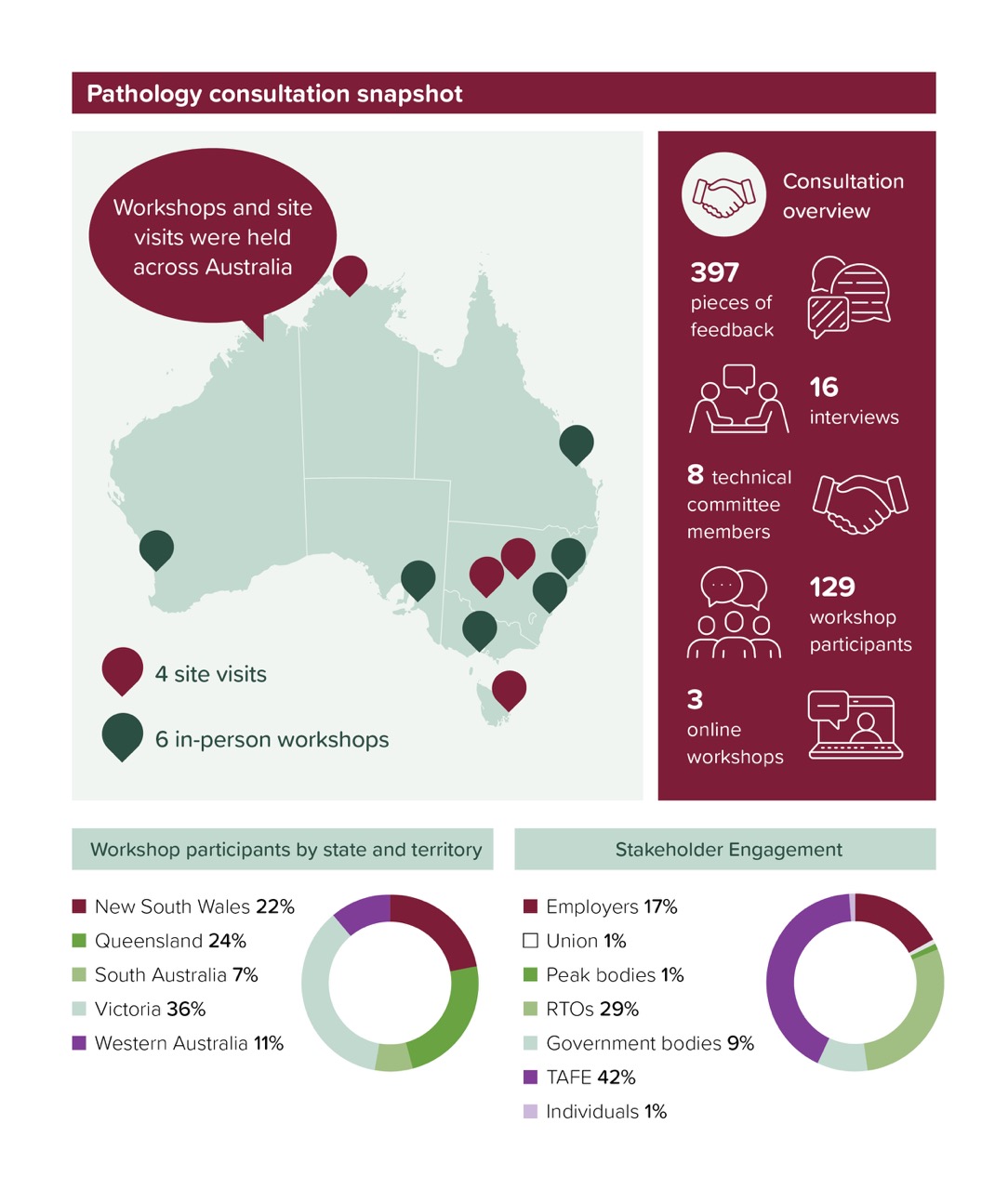
Consultations were held between Tuesday 5 November and Tuesday 24 December 2024.
We collected your feedback through a number of mechanisms including targeted interviews, public workshops, site visits, surveys, phone calls, and emails.
Targeted interviews, public workshops and site visits were conducted with stakeholders providing valuable perspectives on the qualification review. Face-to-face workshops and site visits were held in Perth (5/11/24), Adelaide (7/11/24), Darwin (12/11/24), Brisbane (15/11/24), Newcastle (25/11/24), Sydney (27/11/24), Albury (28/11/24), Melbourne (3/12/24), Canberra (5/12/24), and Hobart (11/12/24). Stakeholders were also provided with the opportunity to participate in online workshops (12/12/24 and 16/12/24) and to submit feedback via survey. The survey for this project closed on Tuesday 24 December 2024.
We would like to thank all participants who provided their feedback and contributed to the development of the draft training products. Here’s what you told us.
Public Consultation Feedback
We have compiled your feedback and summarised it for review in the following report.
Consultation summary report
The draft training product documentation that was made available through the consultation period is available to download.
Draft Training Product Documentation
Overview of the Occupation and Purpose of Qualification Updates
This project review focused on updating the pathology qualifications to reflect current industry practices, strengthen workforce capability and ensure graduates are equipped to meet both current and emerging needs of the health sector.
Pathology workers play a critical role in the healthcare system by collecting, preparing, and processing specimens, conducting diagnostic tests, and supporting accurate medical diagnosis and treatment. They work across hospital laboratories, community pathology services, collection centres and specialist diagnostic facilities, combining technical precision with strong compliance and customer service skills.
The qualifications have been updated to ensure they remain current, relevant and fit-for-purpose, reflecting:
- technological advances in specimen collection, testing equipment and diagnostic processes
- evolving industry requirements for accuracy, infection control and patient-centred care
- workforce demand for graduates who are immediately job ready and adaptable to new testing methodologies
- alignment with national standards, regulatory requirements and industry best practice.
Qualifications and Units Reviewed
The review encompassed the following qualification:
- HLT37215 Certificate III in Pathology Collection
- HLT37415 Certificate III in Pathology Assistance
Units reviewed included core competencies in:
- specimen collection, preparation, and transport
- pathology testing procedures and quality control
- infection prevention and control
- patient communication, privacy, and consent
- workplace health, safety, and regulatory compliance
- digital data entry and diagnostic equipment operation.
Summary of Consultations
We extend our sincere thanks to all individuals and organisations who generously contributed their time and expertise to this project. At its commencement, a Technical Committee of eight members was established, with representation from Queensland, Western Australia and New South Wales. The Committee comprised Registered Training Organisations (RTOs), pathology service providers, peak industry bodies, and employers, all of whom provided ongoing guidance and valuable input throughout the project.
Consultations were conducted between Tuesday 4th November and Tuesday 24th December 2024 using a mix of workshops, surveys, site visits, email submissions, and meetings with subject matter experts (SMEs).
- Online workshops and targeted interviews were held with employers, training providers, regulators, and practitioners from metropolitan and regional settings.
- Site visits provided opportunities to observe workplace practices and validate the relevance of skills.
- Written submissions and survey feedback captured a wide range of stakeholder perspectives.
This extensive consultation ensured that diverse industry views informed the review and that the final qualifications meet both workforce needs and training standards.
Key Outcomes of the Review
1. Training product templates
- Qualifications and skill sets were subsequently updated to align with the 2025 template requirements.
2. Qualification changes
- HLT37215 Certificate III in Pathology Collection and HLT37415 Certificate III in Pathology Assistance were merged into one qualification HLT37525 Certificate III in Pathology
3. New skill set developed
- HLTSS00085 Perform Blood Collection from Children Aged 0 to 5 Years Skill Set
4. New unit of competency developed
- HLTPAT013 Perform venous blood collection from children 0 to 5 years
5. All units had edits to Performance Criteria (PC) and Knowledge Evidence (KE) for enhanced clarity
6. Some units had minor changes to their application
Consultation
- 4 site visits conducted across regional hospital/pathology facilities
- 9 meetings held: 6 face-to-face and 3 online
- 7 technical committee workshops
- 139 informed stakeholders engaged in the review and development of training package components
All feedback has been recorded and responded to in the consultation log. A summary of feedback from the Consultation stage and how it has been considered and addressed is included below.
Documents Submitted to the Assurance Body
Qualification
Units of Competency
Skill Sets
Companion Volume Implementation Guide
Supporting documents
- Training Product Submission Form – outlines the project activities, outcomes, and the training products proposed for endorsement.
- List of Training products for submission – details the specific training products submitted for endorsement.
- Consultation log – records stakeholder engagement and feedback, providing evidence to support the submission.
- Anti-Discrimination Assessment – documents the measures and considerations undertaken to ensure compliance with anti-discrimination requirements throughout the project.
This project reviewed the HLT37215 Certificate III in Pathology Collection and HLT37415 Certificate III in Pathology Assistance qualifications, which had not been updated since 2015. The review aimed to ensure the qualifications reflect contemporary industry practices, strengthen workforce capability and equip graduates with the skills and knowledge required to meet current and emerging needs in the health sector.
Following broad public and government consultation, a comprehensive consultation log and summary report were developed, providing clear evidence of industry support for the changes implemented. An anti-discrimination assessment was also conducted to ensure that consultation processes and feedback mechanisms were inclusive and that the language used within the training products does not discriminate, including consideration of any elements that may inadvertently lead to discriminatory outcomes.
The Companion Volume Implementation Guide (CVIG) was updated to support implementation and is complemented by a newly created Foundation Skills Companion Volume for the HLT Health Training Package Release 10.0.
The final training products were submitted to the Skills Ministers for endorsement, supported by Senior Responsible Officers and the Training Package Assurance Body. The qualification and units of competency were endorsed by the Skills Ministers on the 19 December 2025 and published on the National Training Register on 22 December 2025.
HLT37525 Certificate III in Pathology HLT37415 Certificate III in Pathology Assistance
Submission documentation included an Anti-Discrimination Assessment, Consultation Log and Summary Report, providing evidence of industry support for the changes made. The Companion Volume Implementation Guide (CVIG) has also been updated to support implementation.
Summary of changes
All training products have been reviewed and updated based on a thorough analysis of feedback received throughout the consultation process from a wide range of stakeholder groups, including employers, training providers, phlebotomists, peak bodies,and subject matter experts. A detailed account of all the feedback received throughout the consultation process has been documented in a Consultation Log, including stakeholder comments, key themes and how these were considered in the review process.
Key changes include:
Qualifications
Units of Competency
Skill Sets
Consultation summary
Throughout this project, many individuals generously volunteered their time, insights and expertise. We extend our sincere thanks to everyone who contributed to its development. This work was informed by extensive consultation with stakeholders across the sector.
A number of mechanisms were used throughout the project to inform the development and finalisation of the revised training products.
All feedback has been captured and responded to. You can view a summary of feedback, outlining the broad themes and responses.
Professional Development
A series of professional development and implementation workshops were conducted in late January and early February to support the rollout of the new training package. These workshops were designed to provide participants with a comprehensive understanding of the updated training requirements, practical strategies for implementation and opportunities to engage in collaborative discussions with peers.
To support ongoing learning and reference, a recording of the workshops along with the slides and materials are now available. These resources can be used to revisit key concepts, guide implementation within your own context and ensure alignment with the new training package standards.
View recording View presentation
Supporting documentation
Key project submission documentation:
Additional documents referenced in the Submission Form: